

How to Calm Race Day Nerves and Perform at Your Best Despite Performance Anxiety

The start line of a marathon has a unique way of shaking things up. No matter how many miles logged, how dialed in your nutrition, how perfect the taper, or if you’ve had a successful porta potty visit (iykyk). When you’re standing in that corral with thousands of other runners, your nervous system gets revved up and your mind can feel completely hijacked by performance anxiety.
I know how loud and intrusive the mental noise can get. The volume cranks up and thoughts creep in that make you question everything you’ve worked for.
My experience at Grandma’s Marathon was different this year. Why? I intentionally prioritized marathon mental preparation. Standing at the start in Duluth, I felt something I hadn’t felt very often on a race morning: genuine calm.
Not the forced kind of calm repeating an affirmation or mantra, praying to maintain a stable mindset. This time it was a grounded, authentic calm. The kind that comes from self-trust, nervous system regulation, and most importantly—consistent practice.
The Results of Mental Training
By changing my mental approach, I achieved results even I didn’t expect:
- Finished with an 8 minute PR
- Qualified for Boston by over 23 minutes and took 7th in my age group
- Ran 11 and a half minutes faster than I had at the Chicago Marathon just 9 months prior.
And I’ll tell you right now—it had less to do with physical training and everything to do with how I managed my mind.
What Performance Anxiety Actually Is
Performance anxiety isn’t a weakness. It’s not a sign that you’re mentally fragile, or that you aren’t ready for the whistle to blow. Your brain is doing exactly what it was designed to do: scanning for threats, preparing for battle, and trying to protect you from pain or discomfort.
The problem is that your brain doesn’t always distinguish between an actual threat and a perceived threat. A predator in the wilderness and a race you’ve been training for feel surprisingly similar to your nervous system. The result? A flood of cortisol and adrenaline at exactly the moment you need to focus, be present, and trust your training.
Competitive performance anxiety occurs before or during competitions when performers find the situation highly challenging and fear they are unable to perform to their full potential. This anxiety tends to show up in highly recognizable patterns:
- The spiral of “what if” thinking that starts the night before and gets louder in the corral.
- The hyper-monitoring of everything happening around you and the relentless mental chatter.
- The physical tension you carry in your shoulders, jaw, and hands without even realizing it.
As a licensed therapist who specializes in working with high-achieving athletes and professionals around perfectionism, high-functioning anxiety, and burnout – I see this pattern quite often. Here is what I tell every client: The goal is never to eliminate anxiety. The goal is to learn to respond to it differently.
The Before: What My Training and Race Day Used to Look Like
Before I started deliberately training my mind, training cycles and race days were an ongoing mental battle. Leading up to a big event, I would over-read posts, obsessively research online to make the “best” plan, and constantly replay worst-case scenarios in my mind.
Surprisingly, no matter how much physical prep I did, I’d wake up with a familiar twist of dread in my stomach. Even during training runs, I’d hesitate to push harder due to self-doubt, getting stuck in analyzing and judging myself.
I’d get stuck in the “overs” – overanalyzing, overthinking, overpreparing, and overjudging. The harder I tried to force control over variables, the more anxious I became. I underperformed, leaving me exhausted and confused because it felt like my hard work was “never enough”. Because I’d definitely put in the work – just not the mental reps I truly needed.
The Turning Point in Chicago
Two races highlighted my pre-race nerves more than ever. After the second one, the Chicago Marathon, it became undeniably clear that a critical piece was missing. My physical training was solid, but my race day mental preparation was subpar. And the results again made me feel like I came up short.
Throughout that training cycle, I held back out of a fear of failure and the heavy weight of my own expectations. My anxiety created a gap between what my body was physically capable of and what my mind would allow. That gap cost me time. Even worse, I left that race feeling emotionally drained, unsatisfied, and mentally discouraged.
I had to get honest with myself about something I already knew professionally: physical training alone is not enough. Although I was efficient at anxiety management in other areas of my life, I had forgotten a key pillar of athlete anxiety management.
If you don’t train your brain to handle discomfort and direct your attention under pressure, you leave untapped performance potential on the table. Which is exactly what happened in Chicago and what led me to a new framework.
The Mental Training Framework for Performance Anxiety
Overcoming anxiety before a race requires the same commitment you give to a physical training block. It isn’t a quick fix, a last-minute app download during race week, or listening to a pep-talk podcast on the way to the start line. It is a consistent, intentional practice built over time.
Here is the framework I used to retrain my mind.
1. Training the Brain to Handle Discomfort
One of the biggest misconceptions about endurance sports is that mental toughness is about grinding it out and pushing through pain. While grit matters, that approach misses the nuance of nervous system regulation.
Discomfort tolerance is a cognitive skill and like a muscle, it can be trained.
Instead of trying to escape or avoid the anxiety, I practiced learning to be with the discomfort. In training, that looks like staying present during hard miles. It means noticing the physical discomfort, naming it for what it is, and consciously choosing your response rather than automatically reacting to it. Expanding my awareness and opening up instead of hesitating or avoiding.
When it comes to managing performance anxiety, you have to recognize that pain is a signal your brain sometimes confuses for a true threat. By training your mind to notice, open up to, and accept the sensation, you can move through the discomfort instead of running from it. Over time, this transforms your relationship with difficulty. It becomes data you can process, allowing you to respond with intention rather than fear.
2. Focus and Attention Training
At its core, anxiety is an attention problem. When anxiety takes over, your focus gets hijacked. Your attention gets “hooked” towards unhelpful thoughts and negative narratives. You stop running the mile you are in and get stuck in your head.
Fortunately, attention is a trainable performance skill. So, I committed to a daily practice of deliberately redirecting my focus back to my breath, my form, and the present moment. Your mind wanders, you notice it without judgment, and you gently return to your anchor. Repeating this hundreds of times strengthens that neural pathway.
During training runs, whenever my brain jumped ahead or started getting “hooked”, I brought it back to my breath or expanded my awareness. I didn’t force or resist the thoughts – I trained the muscle of present-moment focus.
3. Mindfulness and Meditation as “Mental Reps”
Many athletes misunderstand meditation. They assume they aren’t good at it because their minds are too busy, or they shrug it off as unnecessary, so let’s look at it differently:
Meditation is mental training.
Every session is a rep. Every time you notice your mind has wandered and you bring it back, you are building the exact skill you need when your brain starts to spiral or when the “overs” start to win on race day.
Leading into Grandma’s Marathon, I maintained a consistent—not perfect, but consistent—practice. I showed up for it the way I showed up for my runs because I stopped treating it as optional. The return on that investment was a race day where I felt fully present, calm, and confident.
4. Shifting the Perfectionism Piece
Perfectionism and performance anxiety are deeply intertwined, especially in high-achievers and athletes. It sounds like needing things to go just right, to follow a specific plan. Your inner critic gets incredibly loud the moment your effort wavers, or you get stuck attaching your entire sense of self-worth to a result. (Read more on breaking the cycle of perfectionism)
Letting go of the need for a perfect outcome is one of the most liberating things you can do for your performance. Ironically, releasing it reduces the internal struggle and produces much better results.
Grandma’s Marathon: The Mental Work Showed Up
On race morning, the early alarm, the bus ride to the start, and the long lines for the portapotties would usually trigger a racing heart and a chaotic mind. My anxiety typically would have hijacked my focus before the race even started.
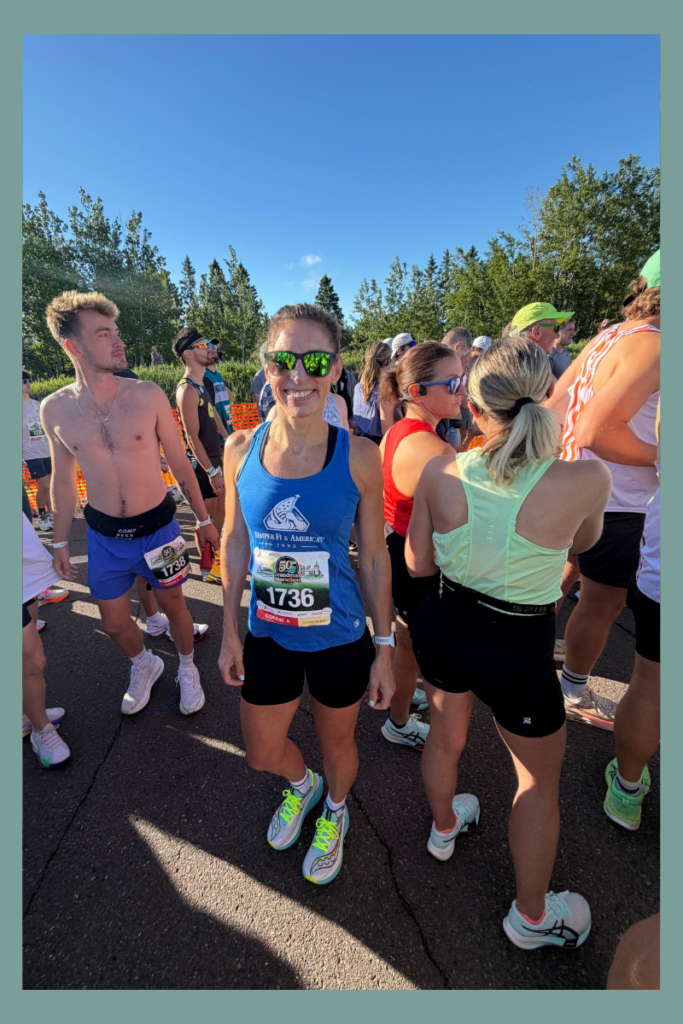
This time, I moved step-by-step through the morning using my grounding practices. I noticed the intrusive thoughts, let them pass, and connected with my purpose. Standing in the corral, I let the nervous energy exist without needing to talk myself out of it and was just present with it.
When the race plan changed around mile 10 and my training partner pulled ahead (she crushed it, by the way!), I stayed in the mile I was in. When my brain generated unhelpful thoughts, I noticed them, named them, expanded my awareness, and returned to my anchor.
When the final miles got genuinely hard (aka the “pain cave”), I had the ability to stay with it rather than give in to the urge to ease up. Leaning into that mental strength allowed me to cross the finish line feeling strong and as a different kind of athlete. One who trained for the psychological demands of the race, not just the physical ones.
What This Means for Your Performance
You don’t have to be a marathoner for these principles to change your life. Performance anxiety shows up in corporate boardrooms, on athletic fields, in auditions, and in high-stakes environments of every kind. Wherever you care deeply about an outcome, your nervous system will have something to say about it.
How to Start Implementing This Framework Today:
- Notice your attention. In your next high-stakes moment, where does your focus go? Is it on the task at hand, or is it jumping toward the outcome and everything that could go wrong? Simply noticing is the first step.
- Sit with discomfort. In your training and daily life, resist the immediate impulse to escape or distract yourself from difficulty. Let it be there. Breathe through it, and choose a conscious response rather than a knee-jerk reaction.
- Build a mindfulness routine. The goal isn’t to empty your mind; it’s to train your attention. Just 10 to 12 minutes a day builds significant mental resilience. Evidence heavily supports mindfulness training to optimize both athletic performance and leadership.
- Examine your perfectionism. If your performance feels like the determining factor of your worth as a person, give yourself space to explore that. Having high standards and tying your self-worth to an outcome are two entirely different things.
Ultimately this will become a practice, a sustainable rhythm of living. The calm I felt on that race morning was the direct result of consistent, intentional work—and it’s a practice that will continue to benefit me long after crossing the finish line.
Overcoming Anxiety and Finding Alignment
Beyond the personal success of hitting a massive PR and qualifying for Boston, this experience proved something much more important to me. The deep, sometimes uncomfortable work I do with my clients—learning to regulate the nervous system, training attention, and loosening the grip of perfectionism—is entirely possible, as well as transferable and transformative.
If you recognize yourself in my “before” version, know that your relationship with anxiety doesn’t have to stay that way. These mental skills are fully trainable.
If this resonated with you, my free resource—The Perfectionist Reset—is a great place to start.
And if you are ready to do the deeper, individualized work, I would love to connect for a Free Consultation.
Learn more at www.livinginalignmentllc.com or follow along on Instagram @calmthementalnoise
Frequently Asked Questions About Performance Anxiety
Q: What is performance anxiety in running?
Performance anxiety in running is the experience of excessive nervousness, fear, or self-doubt that surfaces before or during a race—often despite being physically well-prepared. It shows up as spiral thinking, hyper-monitoring of pace and body sensations, physical tension, and “what if” thought loops that pull your attention away from the path in front of you. It isn’t a sign of weakness or a lack of fitness; it is simply your nervous system responding to high stakes. With the right mental training tools, you can learn to regulate it rather than let it control you.
Q: How do I calm my nerves before a race?
Calming race day nerves starts well before you line up in the corral. It is the result of consistent mental preparation rather than a last-minute mindset trick. Highly effective strategies include maintaining a regular meditation practice to stay present under pressure, practicing intentional attention training to redirect focus away from worst-case scenarios, and building discomfort tolerance during your training cycles. In the hours leading up to the start, grounding techniques like slow breathwork, a familiar warm-up routine, and narrowing your focus entirely to the immediate mile ahead can help regulate your nervous system.
Q: Does meditation actually help athletic performance?
Yes, scientific research strongly supports what many athletes experience firsthand. Meditation improves athletic performance by strengthening the brain’s ability to sustain focus, redirect attention, and regulate the stress response under intense pressure. For runners specifically, a consistent practice builds the exact mental skill you need at mile twenty-two: the ability to notice your mind starting to spiral and gently bring it back to the present moment. Think of every meditation session as a mental rep that compounds over a training cycle to bring you calm, focused control on race day.
Q: How do I stop overthinking during a marathon?
Overthinking during a marathon is ultimately an attention problem. Your focus has shifted from the mile you are currently running to a heavy mental commentary about the miles ahead. The antidote isn’t forced positive thinking; it’s deliberate attention redirection. Practice focusing on something concrete and physical: your breathing rhythm, your running form, the cadence of your footstrike, or a landmark directly ahead. When your brain offers a worry, practice noticing it without engaging with it—acknowledge its presence and return your focus to the physical reality of the present moment.
Stephanie Thomas, MS, LPC, CMHC is a licensed professional counselor and mental performance specialist helping high achievers and athletes navigate anxiety, perfectionism, and burnout. Through her practice, Living in Alignment LLC, she helps clients build the mental skills needed to perform at their best and live with greater presence and purpose.
Leave a Reply
Know that I often hear from clients things like "you're so relatable, this is different than I thought it would be, I can be myself here, "... Maybe it's time to give it a try.


